
75 hospitality leads and 5+ meetings in three weeks for Xenturo Strategies

Xenturo Strategies is a strategy consultancy based in Singapore. They work with travel and hospitality businesses and sell strategy packages from $10K to $25K.
Our job was to book sales calls with travel and hospitality businesses. We measured it by leads and meetings.
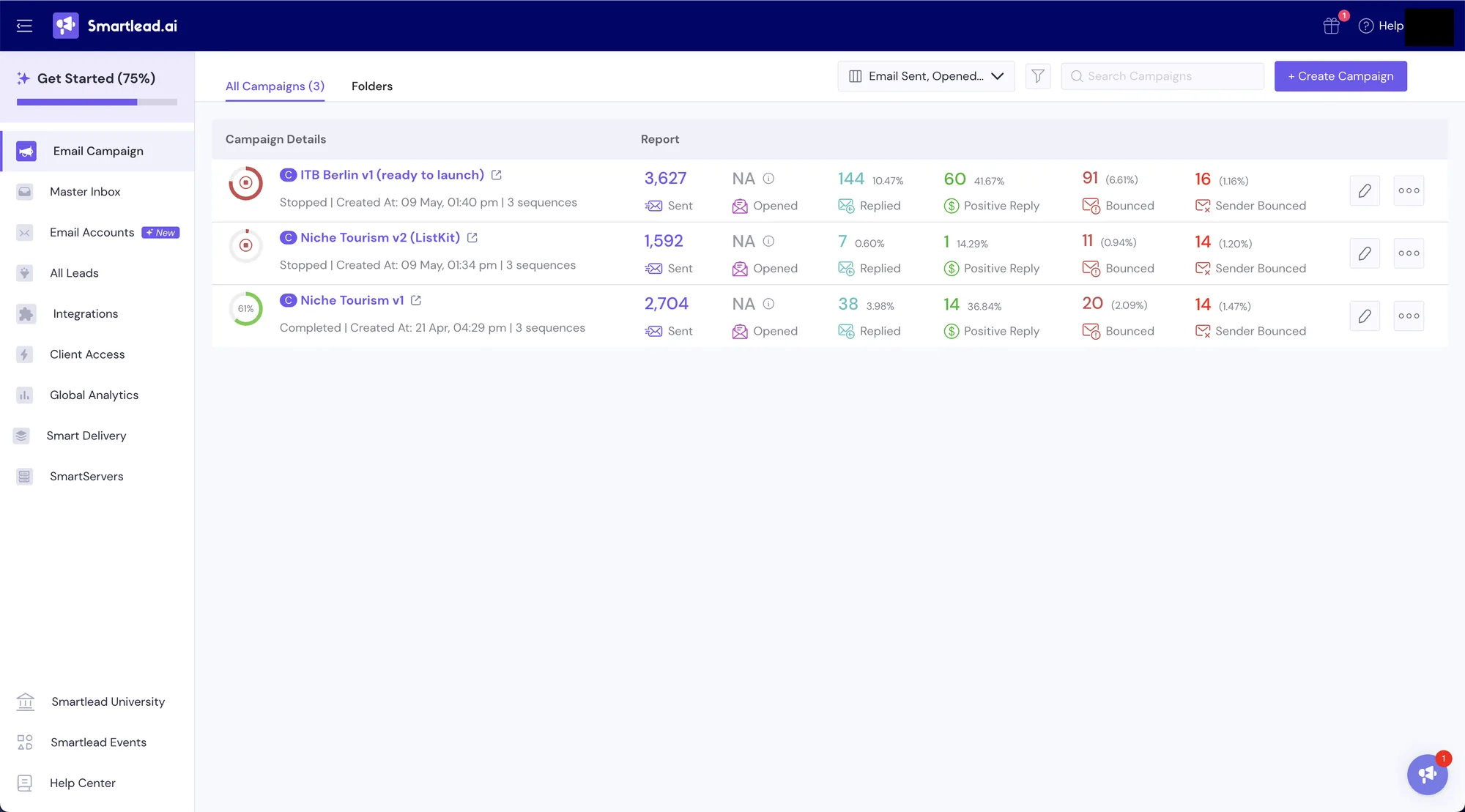
In about three weeks of sending, the campaigns produced 75 positive leads and 5+ booked meetings. One email, sent to the attendees of a travel trade show, did most of the work: 60 positive replies from 3,627 emails.
This case study covers where Xenturo started, the lists and emails we tested, why the trade show list won, and what happened when the leads came in faster than the team could handle.
1. Challenges
All new business came from referrals
Before LeadArc, Xenturo relied completely on referrals. They had no other channel and had never really tried outbound. Referrals are great, but you can't turn them up when you need more clients.
Hard-to-reach buyers
Hospitality is a spread-out market: hotel groups, tour operators, travel brands. Finding the right businesses, getting to their decision makers, and asking for a quick chat about what they were struggling with was the core challenge.
A high-ticket consulting offer
A $10K to $25K strategy package is not an impulse buy. Nobody books one from a cold email. The first email had to start a conversation, not sell the package.
2. What they tried
Referrals only
Every client came through people who already knew them. There was no outbound system, no sending setup and no prospect lists.
3. Our solution
Start from their own sales material
We went through Xenturo's pitch decks, case studies and objection lists. The goal was to find the pain points their buyers actually have, in the buyers' own words.
Each email picked one of those pain points. It named the problem, said we'd helped other hospitality businesses fix that exact issue, and offered a quick chat if it was relevant.
Three lists, tested side by side
- Niche Tourism v1: tourism businesses from ListKit and Apollo.
- Niche Tourism v2: a second tourism list from ListKit.
- ITB Berlin v1: attendees of ITB Berlin, the big travel trade show. We asked for the attendee lists and pulled the names, domains and emails. Xenturo had attended the show too.
The ListKit and Apollo lists did OK. The trade show list did far better.
Three angles, one structure
The tourism campaigns used three versions of the first email, written in Smartlead as sequences A, B and C. Each one asked about a different pain, offered the same proof (a 5-minute video on how Xenturo helped a tour operator add 3.5M in revenue), and ended with one yes-or-no question.
Version A: more customers
Hey {first_name}, thought you'd be the right person to talk to about getting more bookings for {company_name}.

Are you frustrated that you aren't bringing in more customers?

I have a 5-min video showing how we helped a tour operator solve this and add 3.5M in revenue.

Want me to send it over?
Version B: marketing spend that doesn't pay off
Hey {first_name}, thought you'd be the right person to talk to about getting more bookings for {company_name}.

Are you tired of pouring resources into marketing without getting more customers?

I've got a 5-min video showing how we helped a tour operator fix their positioning to add 3.5M in revenue without spending a dollar on more ads.

Want me to send it over?
Version C: direct bookings
Hey {first_name}, thought you'd be the right person to talk to about getting more bookings for {company_name}.

Are you trying to focus more on direct to consumer bookings?

I have a quick 5-min video with the exact steps we took to help a tour operator do that and add 3.5M to their top line.

Want me to send it over?
Each sequence had two short follow-ups. The second repeated the question without the intro. The third simply asked:
Hey {first_name}, I'm following up on my previous messages.

Can I send you a video case study of that project I was talking about?
The direct-bookings question from version C became the core of the ITB Berlin email.
The ITB Berlin email
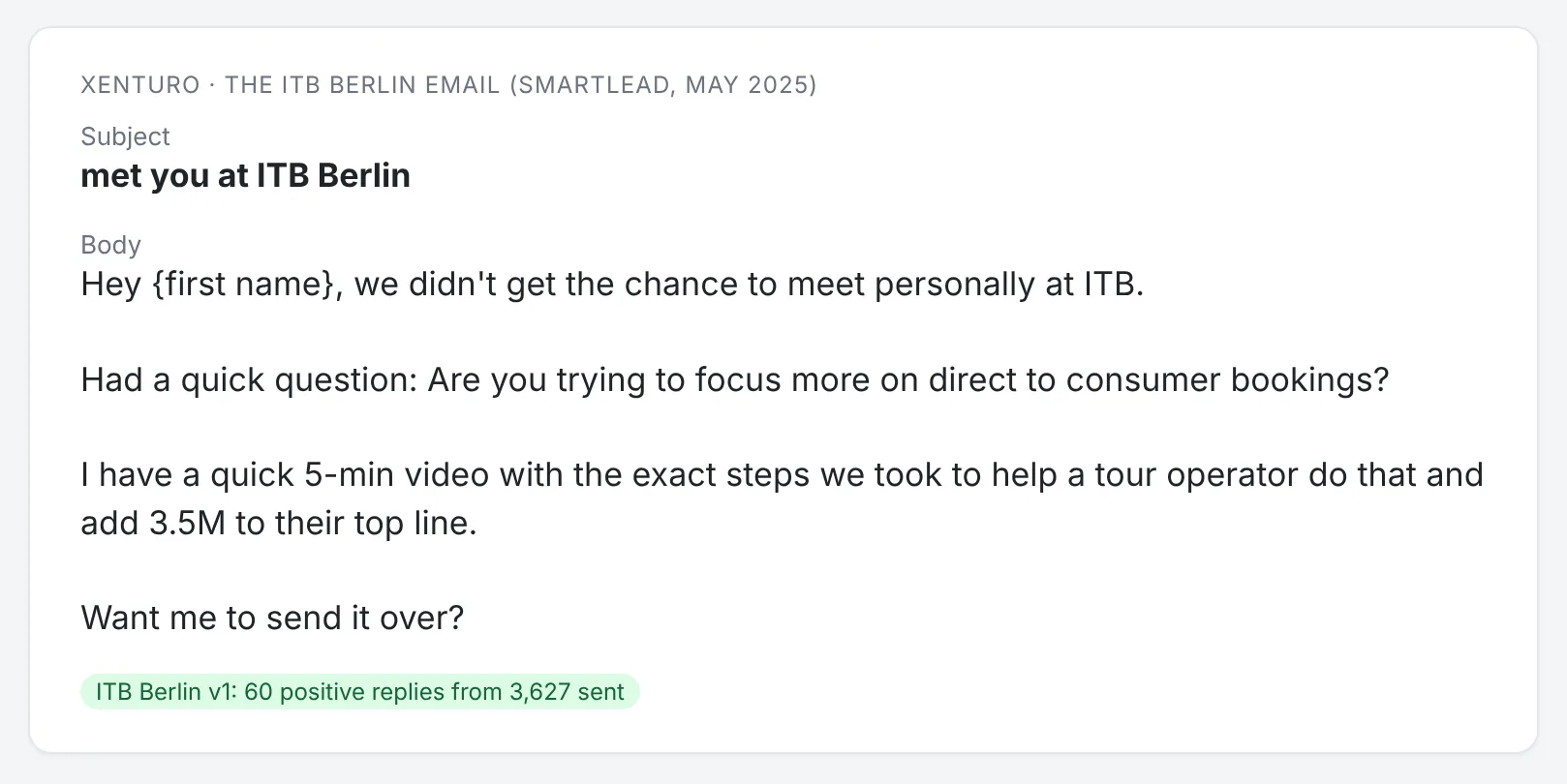
Subject
met you at ITB BerlinBody
Hey {first name}, we didn't get the chance to meet personally at ITB.

Had a quick question: Are you trying to focus more on direct to consumer bookings?

I have a quick 5-min video with the exact steps we took to help a tour operator do that and add 3.5M to their top line.

Want me to send it over?
There were no links in the email. The video case study only went out after someone said yes. That keeps the first email clean for delivery and makes the reply the next step.
We also ran a second ITB version that kept the trade show opener and used the marketing-spend question from version B:
Hey {first_name}, didn't get the chance to talk in person at ITB this March but I wanted to ask you:

Are you also pouring money into marketing without getting more direct bookings?

If so, I can send you this 5-min video showing how we've helped a tour operator add 3.5M in revenue without spending a dollar on ads.

Want me to send it over?
It was less of an offer and more of a case study. It asked one question about one goal hotels and tour operators care about: more direct bookings.
Sending setup
Campaigns ran on Smartlead, from separate sending domains, so Xenturo's main domain was never used for cold email. We used 20 lookalike domains, half on Google and half on Outlook. We used 45 inboxes, warmed up for 14 days before sending. Each inbox sent about 15 emails a day.
Follow-ups for people who replied
People who replied but didn't book went into short follow-up sequences: one for warm leads (an offer to find quick wins on a call, then a full strategy blueprint from a past client), and one for people who said the timing wasn't right, which checked back in the next quarter.
Replies went straight to the founder
The founder of Xenturo handled the responses herself and booked her own calls. We sent new positive leads to her as they came in, and recorded a short Loom on how to answer them.
4. Results
Bottom line
- 75 positive leads in about three weeks of sending.
- 5+ meetings booked within those first three weeks.
- 60 positive replies from one email, sent to ITB Berlin attendees.
- Week one: 1 of the first 7 leads asked to start partnering.
Source and limits
- All numbers come from the Smartlead campaigns page.
- Smartlead calculates the reply rate per lead contacted, not per email sent.
- "Positive" is the reply label in Smartlead.
- The campaigns ran in spring 2025. The ITB Berlin email went out in May 2025.
The three campaigns
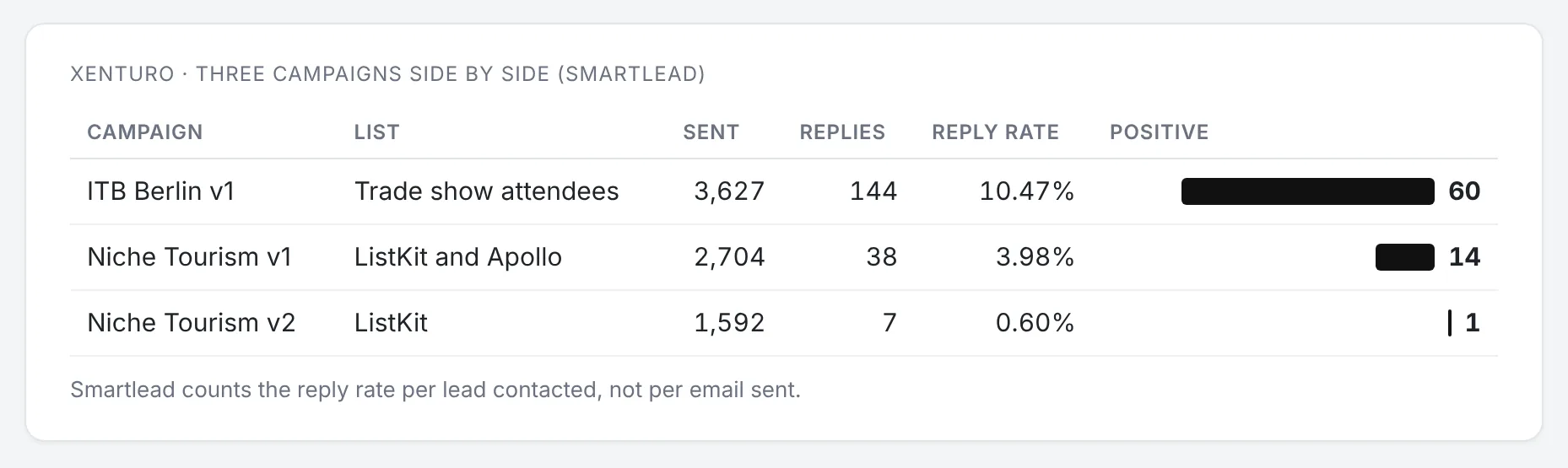
| Campaign | List | Emails sent | Replies | Reply rate | Positive |
|---|---|---|---|---|---|
| ITB Berlin v1 | Trade show attendees | 3,627 | 144 | 10.47% | 60 |
| Niche Tourism v1 | ListKit and Apollo | 2,704 | 38 | 3.98% | 14 |
| Niche Tourism v2 | ListKit | 1,592 | 7 | 0.60% | 1 |
| Total | 7,923 | 189 | 75 |
The trade show list replied about 2.6 times better than Niche Tourism v1 and about 17 times better than Niche Tourism v2. 41.67% of its replies were positive.
Bounces: ITB Berlin v1 bounced 91 emails (6.61%). The two tourism lists bounced 20 (2.09%) and 11 (0.94%). The trade show list bounced the most, and still replied the best by far.
Why the trade show list won
The difference wasn't the copy alone. It was intent. We literally emailed the attendees of the trade show, and Xenturo had attended it too. The email gave them a real, shared moment to anchor on, with a subject line that made sense to them.
The tourism lists from data tools were broader, and the same question about direct bookings got far fewer replies there.
The first week
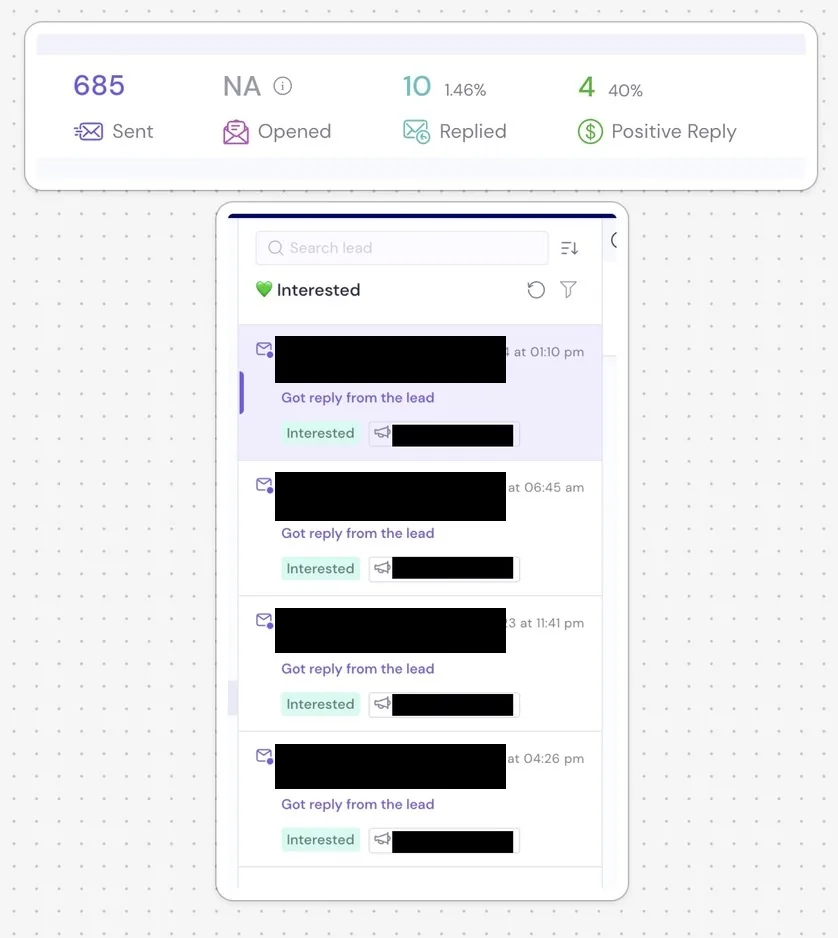
The early numbers showed the idea worked before the big send. The first test sent 685 emails and got 10 replies and 4 positive leads.
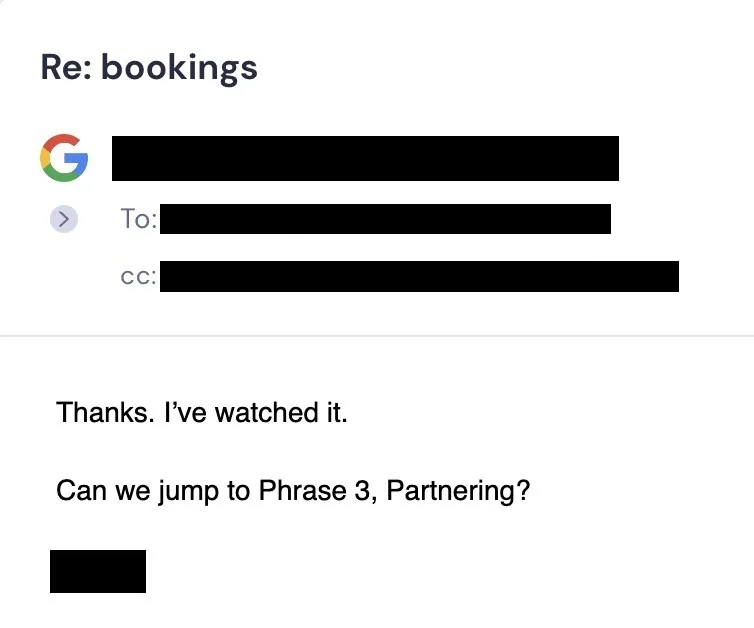
In the first week, 1 of the first 7 leads asked to start partnering. After watching a short Loom, the prospect replied asking to jump straight to "Phase 3, Partnering".
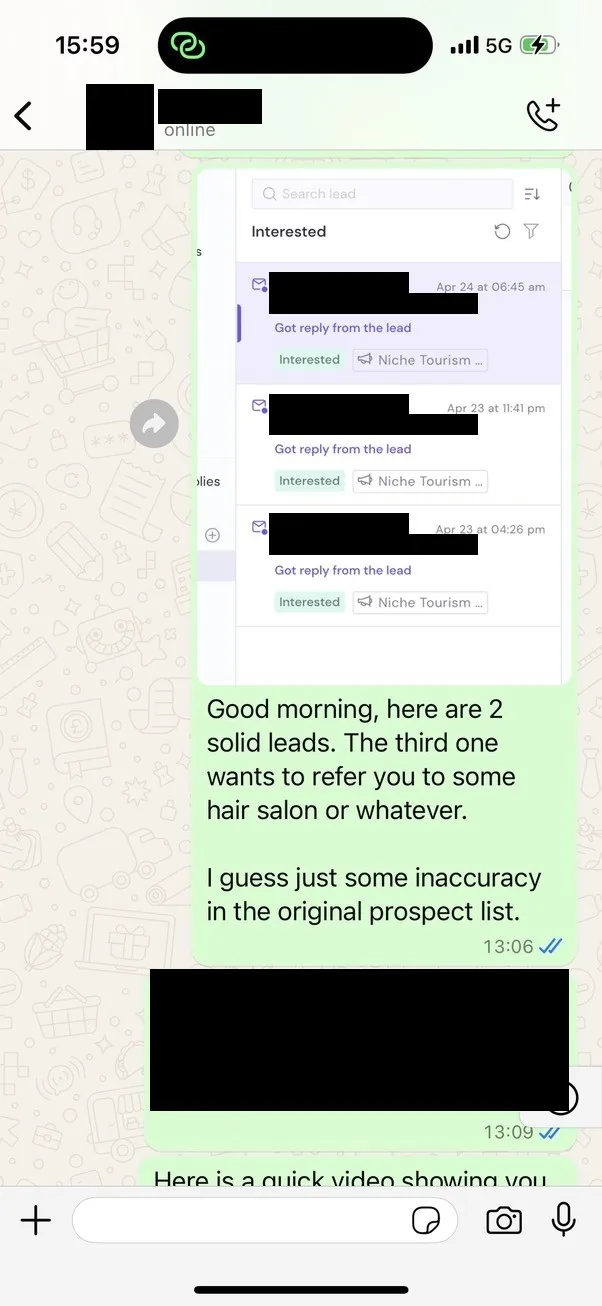
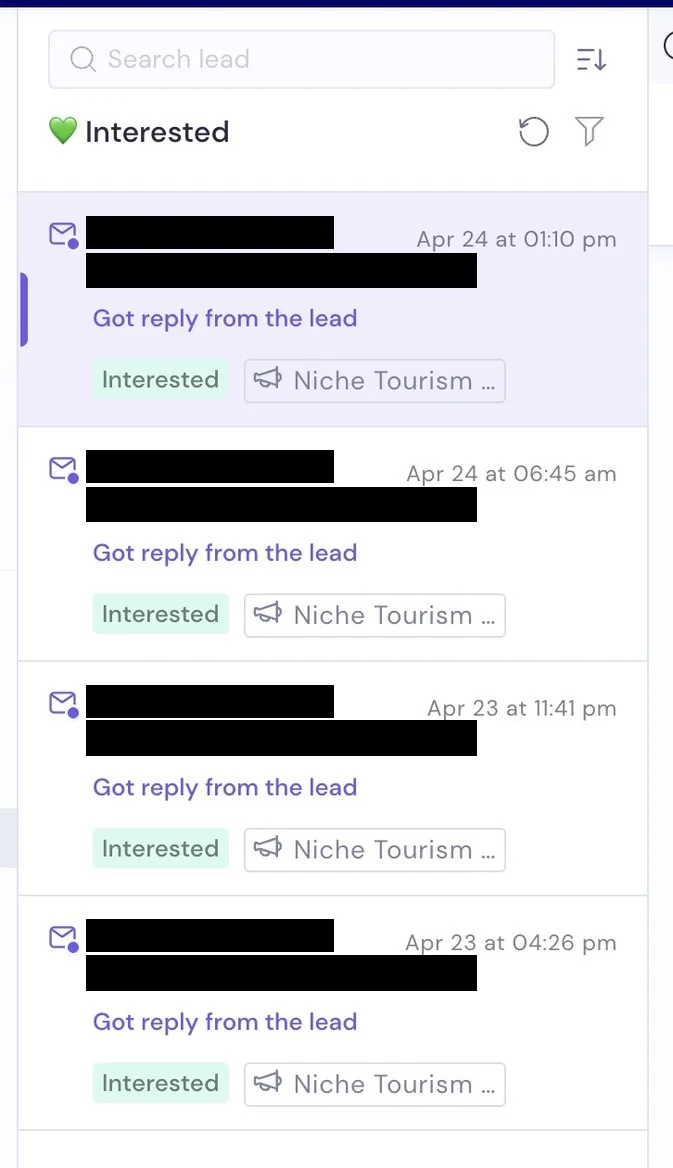
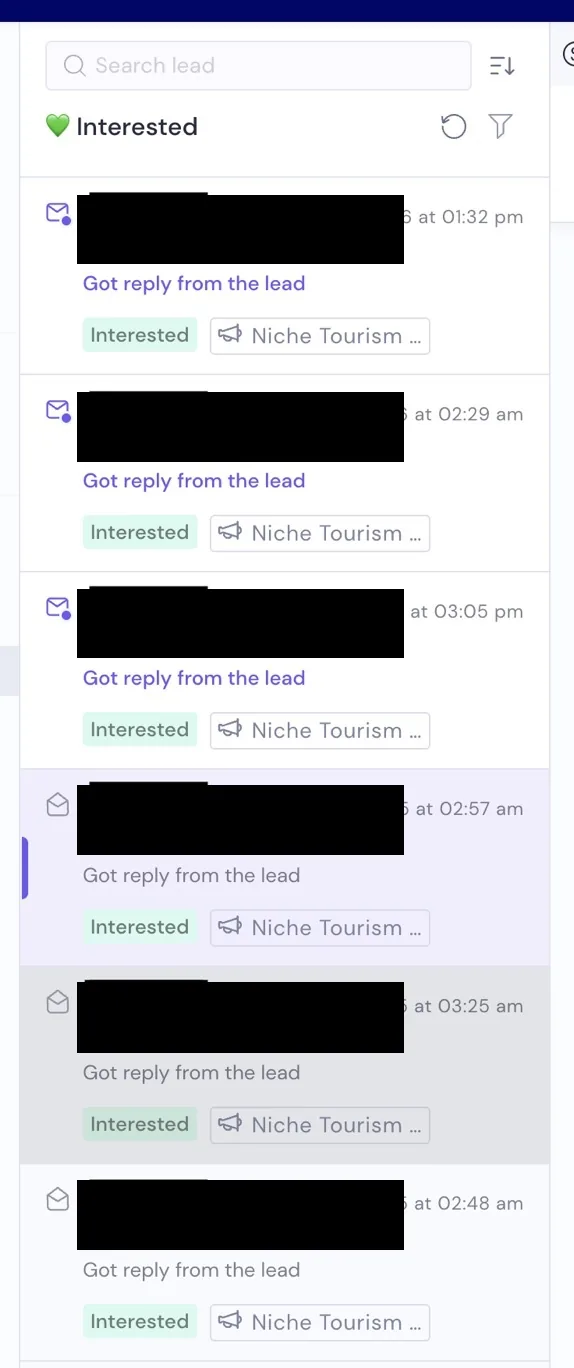
What the inbox looked like
What the client said

How replies were handled
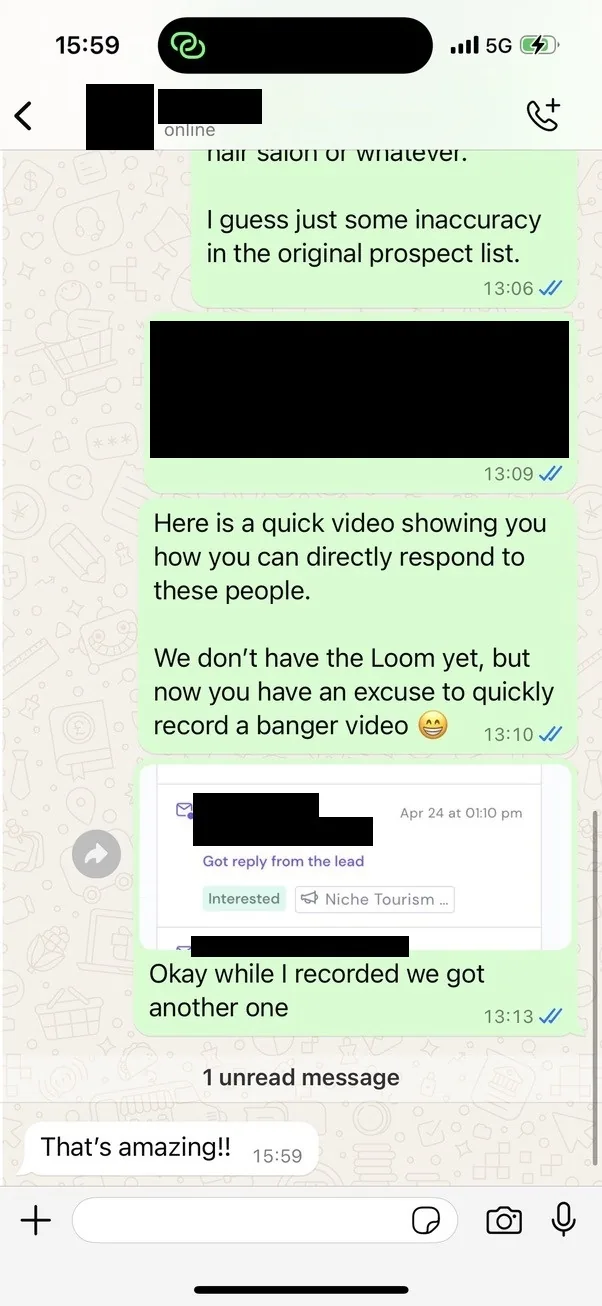
Leads came in fast once the ITB email went out. We recorded a short Loom for the founder on how to answer them. Another lead came in while we were recording it.
How it ended
The lead volume overwhelmed Xenturo's small team. The founder was answering every reply and booking every call herself. They decided to stop the campaigns.
That's a good problem, but it's still a problem. It's the main lesson from this project.
What we learned
Intent beats list size
A smaller list of people with a shared, recent moment beat larger lists from data tools. The ITB Berlin list had fewer contacts than the two tourism lists combined, and it produced 60 of the 75 leads.
Anchor the email on something real
"We didn't get the chance to meet personally at ITB" works because it's true and it's specific. It gives the reader a reason to keep reading.
Sell the next step, not the package
A $10K to $25K package can't be sold in a cold email. A 5-minute video can. The email asked for a tiny yes, and the video did the rest.
No links in the first email
The video went out only after a yes. That kept the first email clean and made the reply the call to action.
Plan for the volume before you turn it on
When one person handles every reply and every call, a good campaign can swamp them. Before scaling, agree on who answers replies, how fast, and how many calls the team can take each week. Then set the sending volume to match.