
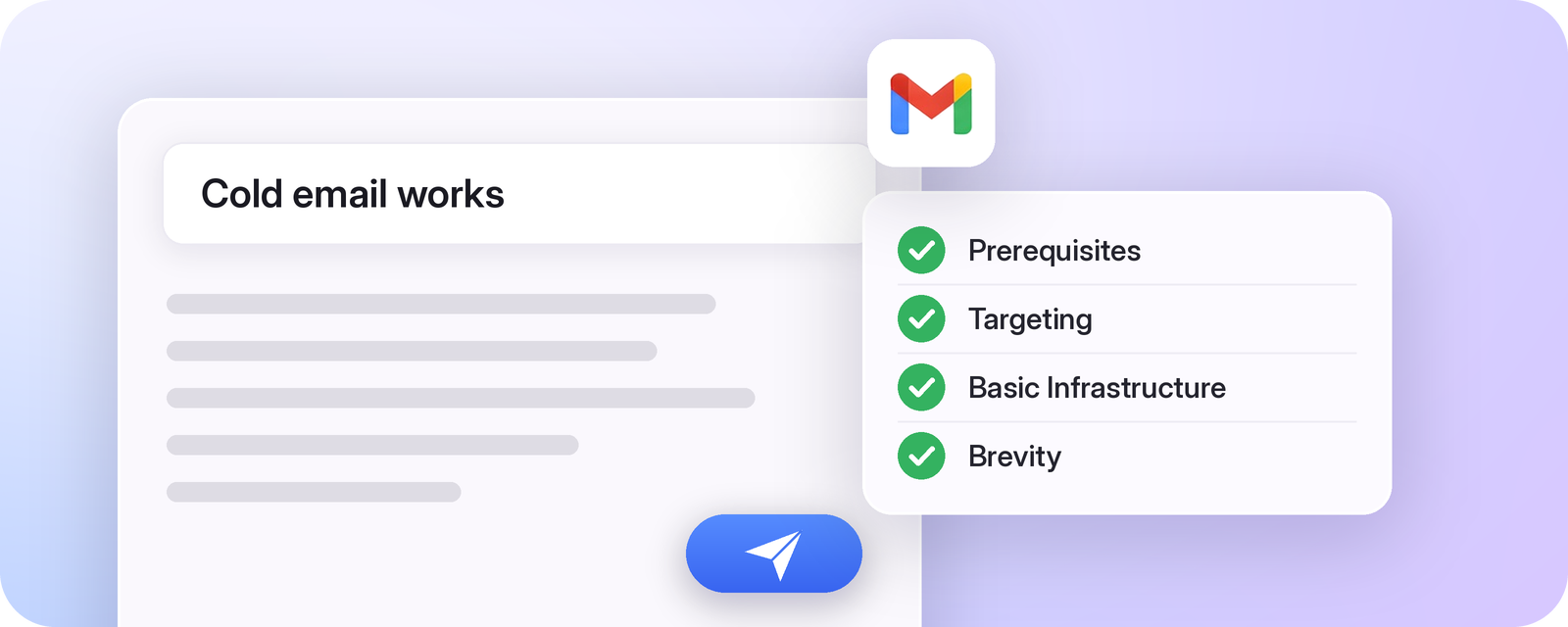
Everything you need to know about cold email

I’ve been doing outbound for 5 years now. Sent over 20 million cold emails and booked thousands of sales calls for me and my clients across software, agencies, manufacturing, and other B2B services.
Doing this, we’ve been able to book meetings with SMBs up to companies like AIRBUS, McKinsey, Lockheed Martin, Salesforce, IBM and more.
I’ll share the 10 most important lessons I’ve learned along the way, so that you can save yourself from trial and error and burning money.
If you don’t want to figure any of this out, and just get results, you can work with us. We send cold emails and book qualified sales calls on your behalf, so that all you have to do it show up and close. If that's interesting, book a call.
1. Prerequisites
There are 4 variables to make outbound work (for any channel). If you have less than two of these, it will be near impossible to get consistent results.
- Case Studies: showing that you have delivered quantifiable results for clients. Case studies are in video format revealing who the client & business is you got results for, and the results you got them are measurable. Minimum 3 case studies.
- Social Presence: you have a following online whether that be on LinkedIn, YouTube, or Twitter. Your face is visible. You regularly produce useful content for your market. You have lead magnets & assets for your market to consume. It's clearly evident that you are not an internet scammer.
- Specific Claim: your offer states an exact quantifiable result that a client will get working with you. Exactly like you're doing right now and why you're seeing this document. Specifically promise a result that is measurable.
- Guarantee: guarantee that your prospects will get the Specific Claim, and if they don't, they get their money back. If you have no case studies, work on a performance basis and only get paid after you get results.
If you have no case studies, and refuse to have a guarantee or work on performance basis, you will never sign a client in your life regardless of what marketing tactic you attempt to do or agency/person you work with ever.
Having Less than 2 of these Variables is capital inefficient & useless. This does not just apply to cold email. It applies to every marketing tactic on the planet.
If you fail to get these, your entire company will fail. It's completely useless to keep the company operating if you refuse to get at least 3 of the Variables present - because nothing is every going to work for you.
Again, if you need help with this, we do this for all of our clients. Book a call with the team.
2. Targeting
You can have the perfect script, perfect deliverability, perfect offers. But if it reaches the wrong people, nothing will work. It's like trying to sell weight loss to skinny people. There's simply no demand, so your supply is useless.
This is why having accurate ICP documentation is super important: having clear criteria for who you want to work with and who is not a good fit.
If you don't have these yet then simply ask yourself what would need to be true in order for someone to actually get results from your service. Anyone who doesn't match that criteria is automatically disqualified. You come up with a basic list of criteria.
If your market is big and you have multiple ICPs, then segment your lists as much as you can and personalize the offers to those segments because your results will be much better.
3. Basic Infrastructure
Again just like with the others, this is another crucial piece that you need to get right because even if your segmenting and offer are great, if your emails don't reach the inbox, then you won't get results (because no one is going to read what you came up with).
Here's a simple deliverability checklist:
- Don't send images or links in the first email.
- Don't use a signature.
- Don't send AI-slop
- Send 15-20 emails per day per inbox.
- Connect about 2-3 inboxes to one domain.
- Avoid using $ or currency signs within the copy.
- Keep the email short and to the point.
- Don't use unsubscribe links or anything similar.
- Don't ask for specific responses like "Respond X and I'll send you Y."
- Only send to verified emails.
- Opt out people who unsubscribe.
- Vary the copy you send out and use multiple variants and spintax.
- Use private infrastructure if possible (EmailBison).
- Use Google Inboxes, diversification doesn't matter
- Warm up new domains for 2 weeks
4. Brevity
Keep the email copy as short as humanly possible. Frequently ask yourself which words you can remove while still keeping the meaning. Every word you add requires attention and the attention from your prospects is limited so you should get to the point as fast as possible.
One of our best-performing cold emails was one sentence without an introduction, without anything, and we simply stated the offer that we came up with.
"If we did [offer] in [time] and you have this [risk reversal], would you be interested?"
That was the whole email. They got amazing response rates because the offer was good
5. Cold Traffic Offers
Cold traffic offers are perhaps the most important thing in this entire video. An offer is basically a way to position the service or product you sell in a way that is attractive to a stranger so that they take action to book a call.
A good cold traffic offer has four components:
- Logistical intensity, which means the more done-for-you your solution is, the better it will work. The more work you do for them, the better it's going to convert.
- Risk. I already covered this briefly earlier but every person who sees your offer for the first time is going to ask themselves, "What if this doesn't work?" You need to answer that question. If you have a bunch of case studies you don't need this but if you have less than three then you absolutely need a guarantee or a pay-on-performance type of payment structure.
- Speed. This is one of my favorite variables to tweak in any offer because everyone wants fast results. The faster you can get results, the more action people will take.
- A specific outcome, so a new opportunity to make new money. The offer should either make or save money. Nice-to-have's usually don't sell well.